
Pumice + ash
Santorini soils combine pumice, ash, sand and other volcanic fragments. Their particle size and porosity govern how quickly water moves and where small reserves can persist.
Assyrtiko × volcanic soil
Santorini is not simply ‘volcanic soil.’ It is porous pumice and ash, scarce rain, strong wind, low basket training and a grape adapted to that complete system.
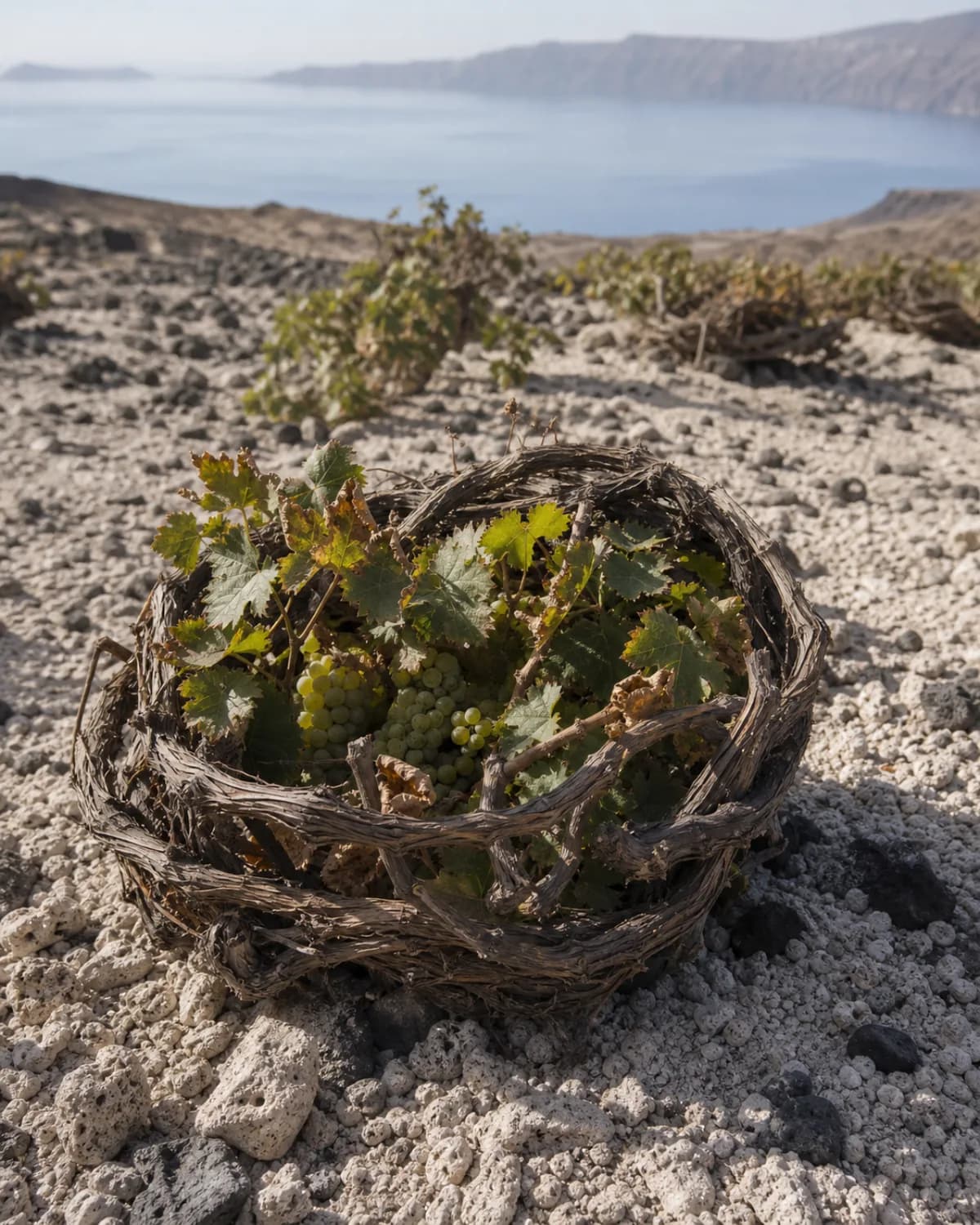
Pumice, ash, wind and a low basket work as one vineyard system.
Search uses your saved shopping location. If none is set, Genuine Grape asks where you shop before looking for current bottles.
A volcanic profile without the lava cliché
Santorini’s volcanic material is sandy and low in clay. Pumice pores, particle size, rainfall and night humidity all matter—but the vine only uses the water that reaches and remains in its root zone.
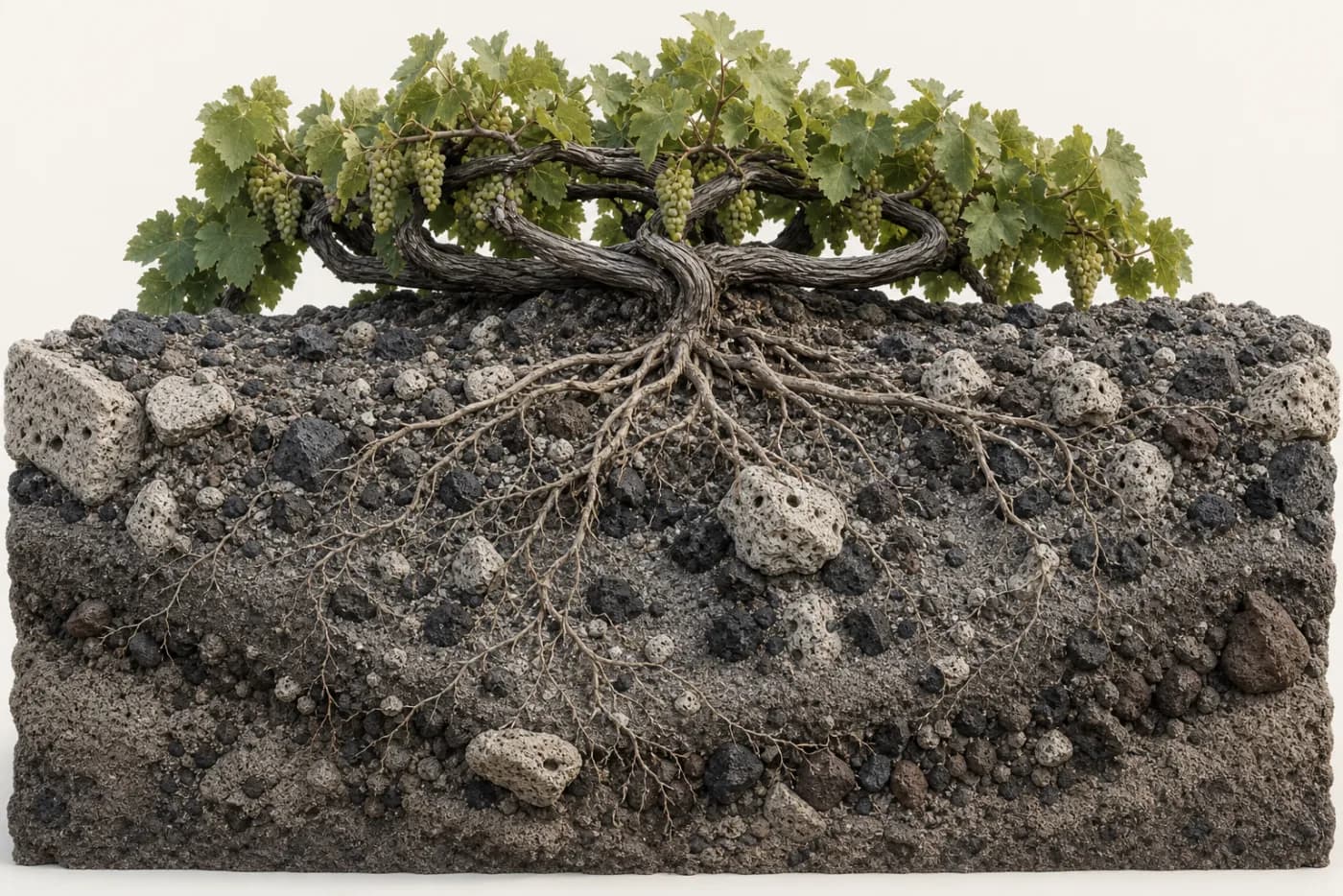
Santorini soils combine pumice, ash, sand and other volcanic fragments. Their particle size and porosity govern how quickly water moves and where small reserves can persist.
The sandy, low-clay profile is central to Santorini’s phylloxera history. It also means the soil behaves differently from clay-rich volcanic vineyards elsewhere.
Strong winds can damage shoots, increase water loss and sandblast fruit. The low woven kouloura shelters clusters close to the ground.
Rain is scarce and vintage-dependent. Porous material, night humidity, training system and root distribution all influence the water available to the vine.
Why Assyrtiko can retain such vivid acidity
Assyrtiko’s acidity belongs to berry metabolism, not dissolved volcano. Heat, water status, location, harvest timing and fermentation influence how it arrives in the glass.
Research: Vineyard location and Assyrtiko ripeningIn the berry
These are grape acids. They are not extracted intact from pumice or basalt.
Across the island
Different Santorini locations can reach harvest with different fruit composition.
Inside the basket
The low woven canopy shelters clusters from wind and extreme exposure while affecting vine water status.
In fermentation
Fermentation organisms and nitrogen availability can change aroma even when the vineyard is unchanged.
KLR
Kouloura protects clusters and changes vine water response
01
H₂T
Tartaric acid is made by the grape
02
H₂M
Malic acid is sensitive to heat and ripening
03
Four clues beyond the volcano
Assyrtiko can be austere, broad, smoky, waxy or oak-shaped. The cellar record helps explain which one is in front of you.
PICK
01
Acid + ripeness
Location and vintage move ripening unevenly. Harvest timing is closer to the measured acidity than a generic volcanic claim.
Research: MDPI: vineyard location and ripeningVES
02
Oxygen + aroma
Neutral steel can foreground fruit and acidity; oak contributes aroma and texture. Neither choice changes where the grapes grew.
Research: UC Davis: oak compoundsLEE
03
Texture
Time on lees and stirring alter texture and aroma integration, sometimes softening the impression of high acidity.
Research: AWRI: lees contactSKIN
04
Grip + colour
Maceration duration and pressing change bitterness, grip, colour and aroma. Check whether the wine was made conventionally or with extended skin contact.
Research: OENO One: phenolic transformationOne rock label, several root environments
Santorini’s volcanic material is sandy and low in clay. Pumice pores, particle size, rainfall and night humidity all matter—but the vine only uses the water that reaches and remains in its root zone.
Root zone
Highly porous fragments can interact with small amounts of rain and humidity.
Vine
Roots occupy the granular matrix around the stones.
Watch
Pores do not guarantee a large plant-available reserve.
Root zone
Fine and coarse particles drain differently and can shift with wind and cultivation.
Vine
Root distribution responds to depth and compaction.
Watch
‘Volcanic’ does not specify texture.
Root zone
Basaltic and andesitic pieces add physical heterogeneity to the profile.
Vine
Roots route around stones through the finer matrix.
Watch
Dark colour is not a flavour mechanism.
Root zone
Clay, rainfall and weathering can differ completely on another volcano.
Vine
Assyrtiko may meet a very different water and nutrient system.
Watch
Do not export the Santorini story to every volcanic vineyard.
One grape, one famous volcano—and two controls
Mainland Greece and Australia help reveal what belongs to the variety, what belongs to Santorini and what belongs to the cellar.
Volcanic · basket-trained · PDO
PDO Santorini is the defining volcanic expression: Assyrtiko-led wines from sandy volcanic soils, with old self-rooted vineyards and basket-trained vines shaped by wind and drought.
Confirm PDO, producer and élevage.
Different soil · different water
Assyrtiko grown in northern and central Greece lets the grape be compared without Santorini’s exact volcanic, wind and training system. Climate, irrigation and cellar style become easier to see.
Use it as a grape comparison, not a volcanic substitute.
New region · new geology
Australian Assyrtiko shows how the variety travels into a different geology and farming context. It is a useful counterpoint, not evidence that every Assyrtiko behaves like Santorini wine.
Compare climate, farming and vessel with Santorini.
Predicting the bottle in front of you
The soil name becomes useful only when it sits beside place, vintage, farming and cellar choices.
Check for PDO Santorini and the documented vineyard. Assyrtiko is now grown beyond the island, often on non-volcanic soils.
Rainfall, heat and vine water status alter ripening. Even on the same island, altitude and location can produce different fruit.
Stainless steel, concrete, amphora and oak change oxygen exposure, aroma and texture. Volcanic origin does not tell you which vessel was used.
Lees ageing, bâtonnage and skin contact can broaden texture and alter aroma. Read these choices before calling the wine’s weight a soil signature.
Evidence, not geology folklore
This guide uses research and official regional sources. Bottle-level soil and winemaking still need to be documented for an individual search match.
Both vineyard images are original editorial illustrations; they do not depict a named vineyard, and the cutaway is not to scale.
Frontiers in Environmental Science
The Value of Soil Knowledge in Understanding Wine TerroirWines of Greece
PDO Santorini soils, varieties and wine stylesWines of Greece
Santorini climate, pumice and Assyrtiko vineyardsOENO One
Kouloura training, water status and heat protectionIVES Technical Reviews
The unique and extreme vineyards of SantoriniMDPI
Vineyard location and Assyrtiko ripening on SantoriniPlants
Water deficit and Assyrtiko grape compositionACS Food Science & Technology
Fermentation yeast and Assyrtiko sensory profileIVES Open Science
Nitrogen, fermentation kinetics and Assyrtiko aromaEUR-Lex
Santorini PDO specification and basket trainingAssyrtiko and volcanic-soil questions
Does volcanic soil make Assyrtiko taste salty?
Not in a direct, proven transfer. Salinity is a sensory description. Volcanic ground changes the root environment, while grape composition, sea-influenced climate, fermentation and tasting context all contribute to the finished wine.
Why are many Santorini vines self-rooted?
Santorini’s sandy, very low-clay volcanic soils have historically limited phylloxera, allowing many vineyards to remain on their own roots. That does not make every vine equally old.
What is a kouloura vine?
It is a traditional low basket training system made by weaving the vine’s canes into a circular form. It protects clusters from strong wind, blown particles and intense exposure.
Does volcanic soil create Assyrtiko’s acidity?
No. The grape produces tartaric and malic acids. Temperature, water status, harvest timing, potassium and winemaking influence how that acidity appears in the bottle.
Is all Assyrtiko from Santorini?
No. Assyrtiko is grown across Greece and in countries including Australia. Look for PDO Santorini when the island’s volcanic system is what you want.
Can Genuine Grape find volcanic Assyrtiko near me?
Yes, when the origin and vineyard information are documented. Run the search, set where you shop if needed, and Genuine Grape will compare matching bottles from supported local wine shops.
Turn the island story into a search
Set where you shop once. Then compare matching bottles, prices and current merchant availability in that market.