
01
Rain leaves the surface quickly. Porosity decides what the rock keeps.
Open fissures drain water downward. Connected pores in chalk and softer limestone can retain part of it, while dense hard limestone may offer little storage.
Chardonnay × limestone
Limestone can drain fast, store water in pores and make some nutrients harder for roots to access. That changes the fruit arriving at harvest. It does not put chalk, butter or flint into the glass.
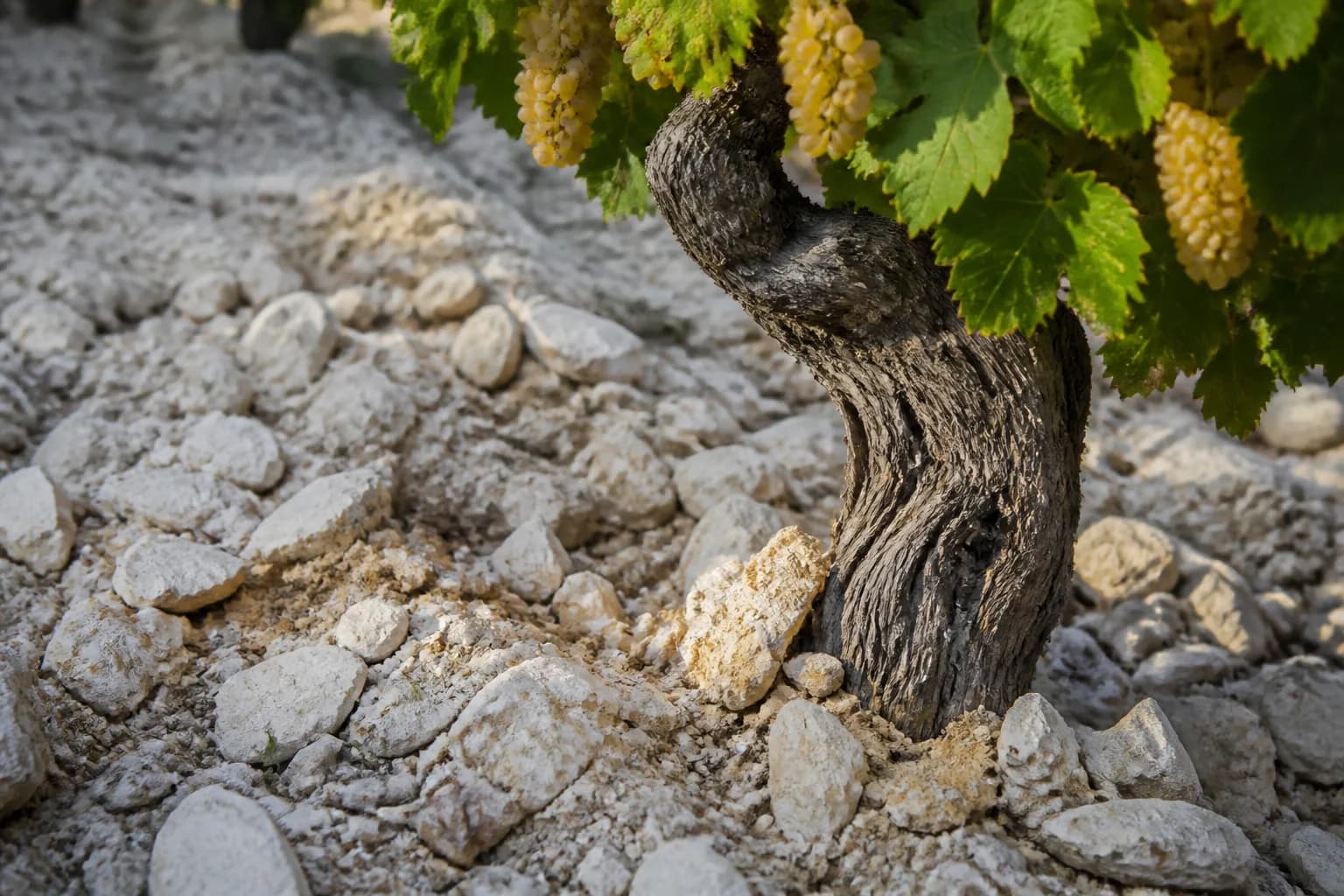
Read the root zone before the tasting note.
Search uses your saved shopping location. If none is set, Genuine Grape asks where you shop before looking for current bottles.
How limestone reaches the grape
A limestone vineyard is never just exposed white rock. The useful root zone includes pores, fractures, weathered material, clay and marl—and each site combines them differently.
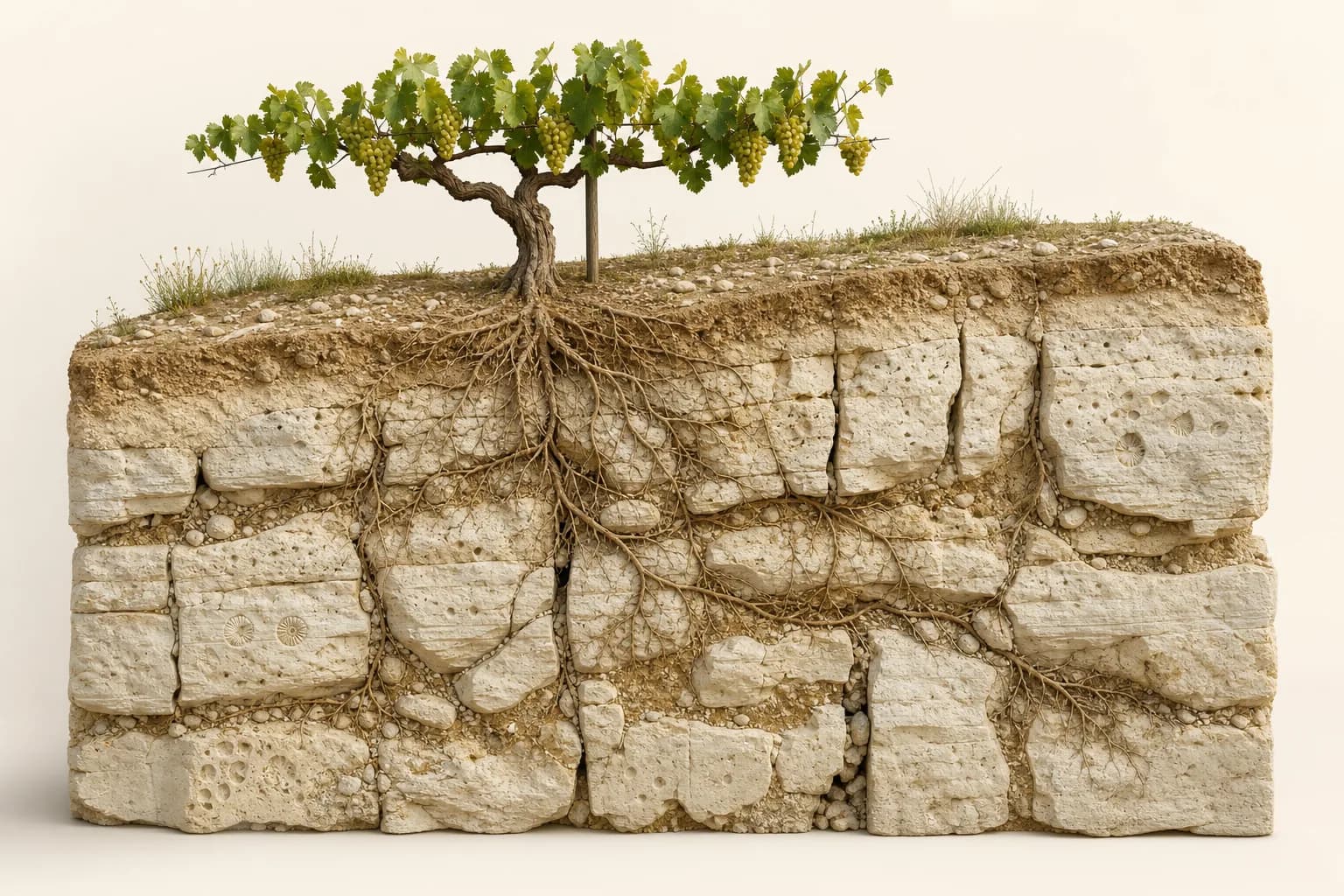
Roots explore cracks and marl seams; porous limestone and fine earth regulate the water they can reach.
Illustrative cross-section
01
Open fissures drain water downward. Connected pores in chalk and softer limestone can retain part of it, while dense hard limestone may offer little storage.
02
Fine material between stones stores water and exchangeable nutrients. Its depth and texture determine how much of the limestone setting the vine can use.
03
Carbonates can make iron, phosphorus, zinc and manganese less available. Lime-tolerant rootstocks and site-specific nutrition are practical responses.
04
Vine water status, canopy growth and berry temperature affect ripening and the balance of sugar, malic acid, tartaric acid and potassium in the fruit.
Where Chardonnay’s acidity comes from
Soil matters when it changes water supply, canopy growth and berry temperature. Climate and harvest date sit closer to the acid in the fruit; malolactic fermentation can change it again after pressing.
Research: Chardonnay acidity under climate variabilityBefore véraison
These grape acids are already present before ripening accelerates. They do not come from calcium carbonate dissolving into flavour.
During ripening
Temperature and evaporative demand help explain why warmer Chardonnay vintages tend to arrive with lower acidity and higher pH.
At harvest
Picking date sets the raw material for the cellar. Potassium and dilution or concentration also affect the numbers.
In the cellar
Lactic-acid bacteria convert sharper malic acid into weaker lactic acid. A producer can encourage, limit or block that conversion.
H₂T
Tartaric acid remains comparatively stable during ripening
01
H₂M
Malic acid is strongly reduced by warm ripening conditions
02
MLF
Malic acid becomes softer lactic acid after fermentation
03
Four cellar decisions that can outweigh the rock name
Chardonnay makes the cellar unusually visible. Read the vineyard and the élevage together before predicting what a limestone-grown bottle will taste like.
MLF
01
Acid + butter
Lactic-acid bacteria convert malic acid to lactic acid. Bacterial strain, timing and oxygen influence diacetyl, so two wines from similar ground can leave the cellar with very different tension and butteriness.
Research: OSU Chardonnay MLF researchLEE
02
Texture
Yeast cells release mannoproteins, amino acids and other components during ageing. Time on lees—and whether they are stirred—can build breadth and change how fruit, oak and acidity sit together.
Research: AWRI: lees contactOAK
03
Aroma + structure
Oak species, barrel age, toast and contact time change vanillin, eugenol, lactones and other compounds. An unoaked Chablis and a barrel-fermented white Burgundy should not be read through limestone alone.
Research: UC Davis: oak lactonesPMT
04
Struck flint
Phenylmethanethiol is associated with struck-flint aroma in Chardonnay. Its formation and preservation respond to fermentation and ageing conditions, so the smell cannot prove the soil beneath the vine.
Research: AWRI: struck-flint aromaNot every limestone root zone behaves alike
“Limestone” covers chalk, hard limestone, marl-rich mixtures and shallow rubble. The vine experiences the complete profile—not a single geology word.
Water
Drains freely through large pores but can retain a substantial internal reserve and move it by capillary action.
Vine
Roots can access a buffered supply in dry periods where the chalk is fractured and reachable.
Watch
Champagne is the clearest example, but sparkling production and long lees ageing change the final comparison.
Water
Limestone banks sit with lime-rich gray marl; clay content increases water and nutrient retention.
Vine
The mixed root zone can combine drainage with a finer-earth reservoir.
Watch
Use the specific Chablis site, slope and vintage—not fossil shells as a tasting note.
Water
More clay generally increases water holding and cation exchange while slowing drainage.
Vine
Can support more growth and buffer drought, depending on depth and structure.
Watch
Canopy, crop level and harvest timing affect Chardonnay’s ripeness and acid balance.
Water
Dense rock may store little accessible water unless weathered seams and fissures are well connected.
Vine
Rooting volume can be restricted and water deficit can arrive quickly in a dry year.
Watch
Do not assume pale rock means a cool or high-acid wine; climate and effective soil depth still lead.
One grape, three carbonate landscapes
Climate, the mix of marl and clay, harvest choices and the production method change what the same broad geology means in the bottle.
Cool · still · Kimmeridgian
Chardonnay grows here on Jurassic Kimmeridgian strata: limestone banks mixed with gray marl and fossil material. The cool climate, slope, vintage and producer remain essential context for reading any bottle.
Read the climat, bank and producer—not just “Chablis.”
Marl · clay · cellar-shaped
White-wine vineyards sit across a patchwork of limestone, marl and clay. The changing proportions affect water and rooting, while harvest date, pressing, barrel use, lees and malolactic fermentation can strongly reshape the result.
Read the village, vineyard and élevage together.
Chalk · sparkling · long ageing
Chardonnay is closely associated with the chalk outcrops of this Champagne subregion. Porous chalk can drain while retaining a water reserve, but sparkling-wine production and long lees ageing make this a different expression from still Chardonnay.
Read blanc de blancs and production method alongside place.
Predicting the bottle in front of you
Those clues sit closer to acidity, butter, toast, texture and struck-flint aroma than a generic promise that limestone tastes “mineral.”
Start with the appellation and specific site. Chablis, the Côte de Beaune and the Côte des Blancs share carbonate geology but not the same climate, wine style or production method.
Warm ripening conditions accelerate malic-acid loss. A cooler or warmer year can move Chardonnay’s acidity more directly than the word limestone on its own.
Full, partial or blocked malolactic fermentation changes acidity and can change buttery aroma. It is a cellar decision, not a limestone signature.
Barrel species, toast, age and contact time alter oak aroma; lees contact changes texture and integration. Check the producer’s élevage before predicting the glass.
Evidence, not limestone folklore
This guide uses university, wine-research and official regional sources. Bottle-level soil and élevage still need to be documented for an individual search match.
Both vineyard images are original editorial illustrations; they do not depict a named vineyard, and the cutaway is not to scale.
Frontiers in Environmental Science
The Value of Soil Knowledge in Understanding Wine TerroirUSDA / UC Davis
Calcium carbonate and nutrient availability in soilBourgogne Wines
Chablis and its Kimmeridgian limestone and marlBourgogne Wines
Limestone, marl and clay in BourgogneComité Champagne
Chalk porosity, drainage and water storageComité Champagne
Chardonnay and the chalk of the Côte des BlancsIVES / Université Bourgogne Europe
Long-term Chardonnay acidity under climate variabilityOregon State University Extension
Malolactic fermentation in ChardonnayAustralian Wine Research Institute
Lees contact and Chardonnay textureUC Davis Waterhouse Lab
Oak compounds and Chardonnay aromaAustralian Wine Research Institute
Struck-flint aroma in ChardonnayChardonnay and limestone questions
Does limestone make Chardonnay taste chalky?
Not directly. Limestone changes the root environment through water, structure, pH and nutrient availability. A chalky or mineral tasting description is a sensory impression, not evidence that dissolved rock moved unchanged into the wine.
Does limestone give Chardonnay high acidity?
Not by itself. Tartaric and malic acids are produced in the grape. Temperature, sunlight, water status and harvest timing affect how much remains, while potassium and winemaking affect measured acidity and pH.
Why is Chablis associated with limestone?
Much of Chablis is associated with Kimmeridgian strata made from limestone and gray marl containing fossil material. Site, exposure, vintage and producer still create substantial differences between bottles.
Is buttery Chardonnay caused by limestone?
No. Buttery aroma is commonly associated with diacetyl, which can be produced during malolactic fermentation. The bacterial strain, timing, oxygen exposure and later cellar work influence how much is present and perceived.
Does a struck-flint aroma prove a limestone vineyard?
No. Research links struck-flint aroma in Chardonnay to sulfur compounds including phenylmethanethiol. Fermentation and ageing conditions can influence it, so the aroma is not a geological test.
Can Genuine Grape find limestone-grown Chardonnay near me?
Yes, when the vineyard detail is documented. Run the search, set where you shop if needed, and Genuine Grape will look for matching bottles across supported local wine shops.
Turn the guide into a bottle search
Set where you shop once. Then compare matching bottles, prices and current merchant availability in that market.