
Weathering
Granite can break down into coarse sand, smaller mineral grains and clay. Roots experience that weathered profile—not a polished block of stone.
Syrah × granite
Granite matters after it weathers: into sand, clay, fractures and variable soil depth. Those conditions shape the vine. They do not place a crushed-rock or pepper flavour into Syrah.
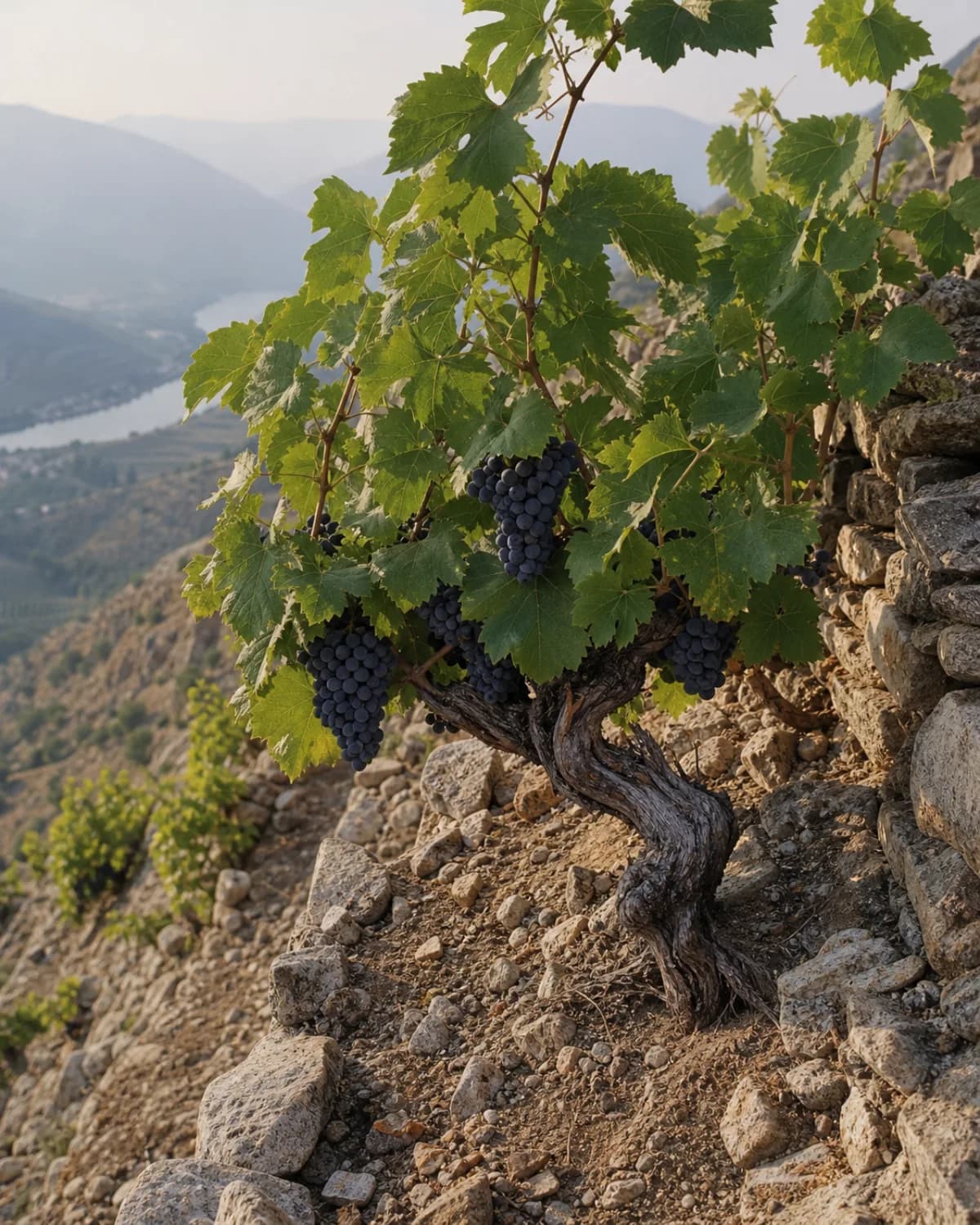
Solid rock becomes fractures, sand, clay and a working root zone.
Search uses your saved shopping location. If none is set, Genuine Grape asks where you shop before looking for current bottles.
From granite block to root zone
A granite vineyard is a profile in motion. Rock breaks down, fine earth moves downslope and terraces redistribute water. Roots respond to the spaces and material that weathering creates.
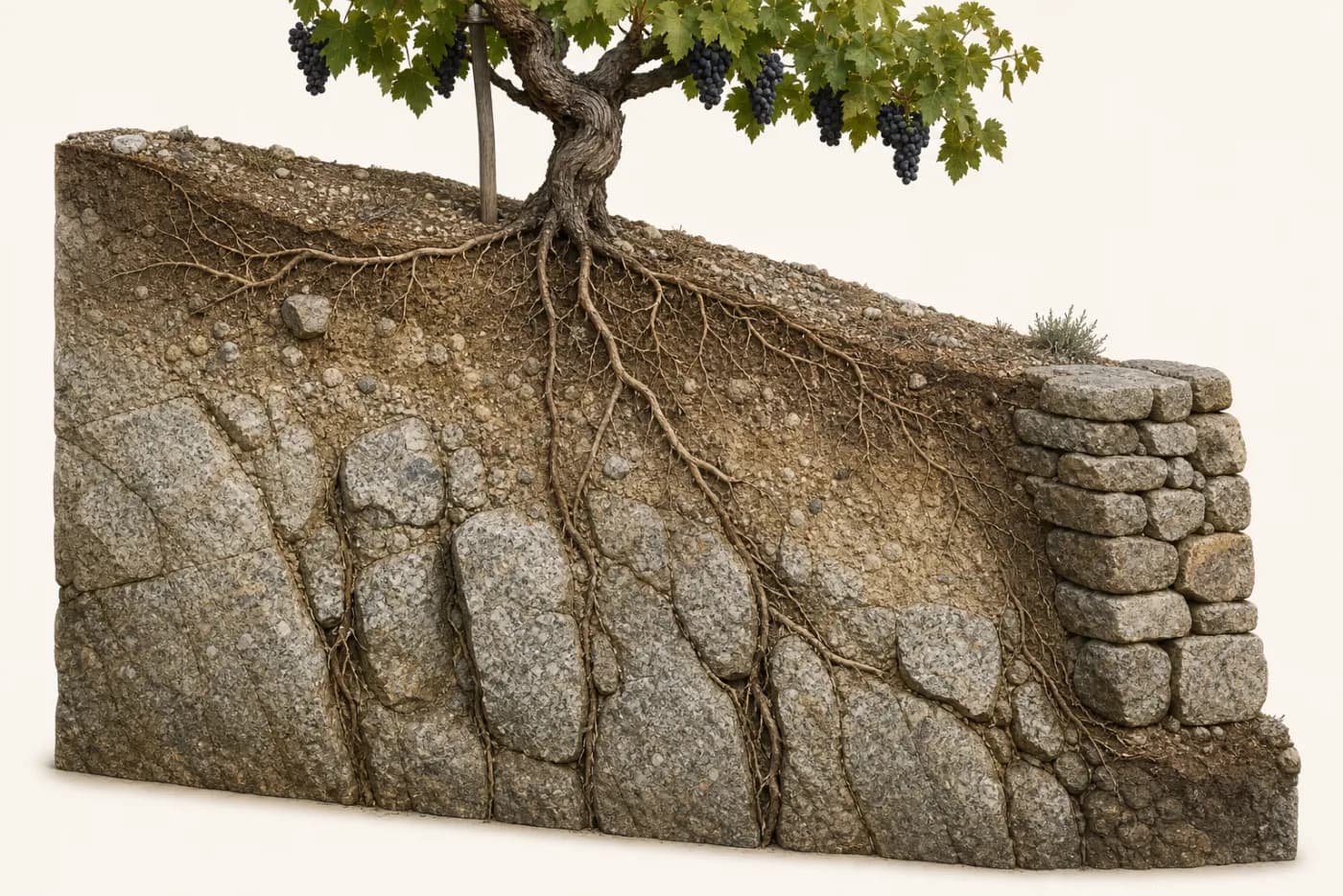
Granite can break down into coarse sand, smaller mineral grains and clay. Roots experience that weathered profile—not a polished block of stone.
Coarse decomposed granite often drains freely, but clay pockets, terrace construction and soil depth decide how much water remains within reach.
Roots can follow joints in weathered bedrock where water and fine earth collect. Dense, unbroken granite offers little usable rooting space.
Terrace angle, aspect and erosion change sun exposure, soil depth and water movement. Those differences can matter as much as the parent rock name.
Where Syrah’s pepper aroma comes from
Rotundone is a potent grape-derived aroma compound. Site temperature, exposure and water status can affect it before harvest; fermentation choices determine how the fruit is handled afterwards.
Research: AWRI: rotundone and peppery ShirazIn the berry
The black-pepper compound is present in grape material. Granite is not its molecular source.
Across the site
Temperature, canopy exposure and water status help explain differences among vineyards and seasons.
At harvest
Pepper sits beside fruit maturity, acidity, tannin and stem lignification—not in isolation.
In the cellar
Intact berries, stems, cap work and oak can change perfume, herbal notes, tannin and texture.
ROT
Rotundone is the grape-derived black-pepper compound
01
H₂O
Water status changes berry development and canopy behaviour
02
WB
Whole-bunch use changes aroma, tannin and texture
03
Four choices that can outweigh the word granite
Granite identifies a parent material. These vineyard and cellar decisions sit closer to the Syrah you actually drink.
WB
01
Stems + intact berries
The proportion of intact bunches and stem maturity affect aroma, pH, astringency and texture. Two neighbouring parcels can leave the cellar very differently.
Research: AWRI: whole-bunch fermentationEXT
02
Colour + tannin
Punch-downs, pump-overs, temperature and skin-contact time determine how colour and tannin move into the wine.
Research: OENO One: phenolic transformationOAK
03
Aroma + oxygen
Oak can add vanilla, toast and oxygen exchange. It should not be confused with the vineyard’s granite setting.
Research: UC Davis: oak lactonesRIP
04
Fruit maturity
A warm exposed vintage and a cooler shaded vintage can express the same granite parcel in materially different ways.
Research: AWRI: water and rotundoneOne rock label, several root environments
A granite vineyard is a profile in motion. Rock breaks down, fine earth moves downslope and terraces redistribute water. Roots respond to the spaces and material that weathering creates.
Root zone
Water and fine earth collect mainly in joints and weathered seams.
Vine
Rooting volume depends on fracture continuity.
Watch
Do not assume every visible crack is deep or water-bearing.
Root zone
Coarse saprolite can drain quickly while retaining water in finer particles.
Vine
Roots can explore a larger, softer profile than solid bedrock.
Watch
Depth and clay fraction change the result.
Root zone
Eroded sand, silt, clay and stones accumulate behind walls or lower on slopes.
Vine
Greater fine-earth volume may support more growth.
Watch
Terrace construction can outweigh the parent-rock shorthand.
Root zone
Schist, gneiss, limestone or alluvium can sit within one appellation.
Vine
Water and nutrient conditions change across short distances.
Watch
Use parcel evidence, not the regional reputation.
One grape, three granite contexts
Weathering, climate, slope and cellar practice turn the broad granite label into very different bottles.
Gores · terraces · Syrah only
Cornas is Syrah-only and largely planted on decomposed granite that forms sandy-clay gores. The appellation also contains silt deposits and limestone in the north, so even this compact amphitheatre is not one uniform granite slope.
Read the terrace and parcel—not just the amphitheatre.
Bessards · mixed hill · parcel-led
The western Bessards sector is strongly granitic, while Hermitage also includes mica-schist, gneiss, alluvial pebbles, limestone, flint and more fertile lower-slope material. Parcel and blend composition matter.
Ask which part of the hill supplied the fruit.
Granite · schist · iron
Swartland Syrah is grown across granite, schist and iron-rich settings. It offers a useful comparison because climate, bush-vine farming and cellar choices differ sharply from the northern Rhône.
Read the documented soil and farming for the bottle.
Predicting the bottle in front of you
The soil name becomes useful only when it sits beside place, vintage, farming and cellar choices.
Ask whether the roots sit in shallow fractured rock, deep sandy saprolite, clay-rich granite soil or a mixed profile. Granite is the beginning of the description.
Rotundone, the compound behind black-pepper aroma, is grape-derived and is often higher in cooler conditions. Warmth and water status can move the wine independently of geology.
Stems and intact berries can change tannin, herbal character and perfume. Check the whole-bunch proportion before attributing a wine’s structure to granite.
Fermentation temperature, cap work, maceration and barrel ageing can reshape colour, tannin, spice and texture after the fruit leaves the vineyard.
Evidence, not geology folklore
This guide uses research and official regional sources. Bottle-level soil and winemaking still need to be documented for an individual search match.
Both vineyard images are original editorial illustrations; they do not depict a named vineyard, and the cutaway is not to scale.
Frontiers in Environmental Science
The Value of Soil Knowledge in Understanding Wine TerroirVins Rhône
Cornas: decomposed granite, gores and local variationVins Rhône
Hermitage geology and named sectorsVins Rhône
Saint-Joseph granite, gneiss and terracesVins Rhône
Rhône parent rock and vine water supplyAustralian Wine Research Institute
Rotundone and black-pepper aroma in ShirazAustralian Wine Research Institute
Whole-bunch fermentation and stem effectsWines of South Africa
Granite, schist and iron in Swartland SyrahOENO One
Pepper aroma and rotundone research reviewSyrah and granite questions
Does granite make Syrah taste like crushed rock?
Not directly. Granite changes the physical root environment through weathering, drainage, depth and fractures. A stony tasting description is not evidence that granite flavour moved into the grapes.
Where does Syrah’s black-pepper aroma come from?
Black-pepper aroma is strongly associated with rotundone, a potent grape-derived compound. Climate, berry exposure, water status and winemaking can influence it; granite is not its chemical source.
Is all Cornas grown on granite?
Decomposed granite is the dominant setting, but official mapping also identifies silt deposits and limestone areas. Bottle-level claims should still be tied to the documented parcel.
Is Hermitage one granite terroir?
No. Granite is important in Les Bessards, but Hermitage contains several geological settings, including schist, gneiss, limestone, flint and alluvial material.
Does whole-bunch fermentation matter for granite-grown Syrah?
Yes. Including intact bunches and stems can change aroma, tannin, pH and texture. It is a cellar decision that should be read alongside the vineyard.
Can Genuine Grape find granite-grown Syrah near me?
Yes, when the vineyard detail is documented. Run the search, set where you shop if needed, and Genuine Grape will look for matching bottles across supported local wine shops.
Turn geology into a bottle search
Set where you shop once. Then compare matching bottles, prices and current merchant availability in that market.