
Granite sand
Weathered granite can form coarse, sandy soil with quartz and feldspar grains. Its depth and clay content determine how freely it drains and what it stores.
Gamay × granite
Granite can shape drainage, rooting and vigour after it weathers. Gamay’s bright kirsch, strawberry or confectionery notes may come much later, when intact berries meet a carbon-dioxide-rich ferment.
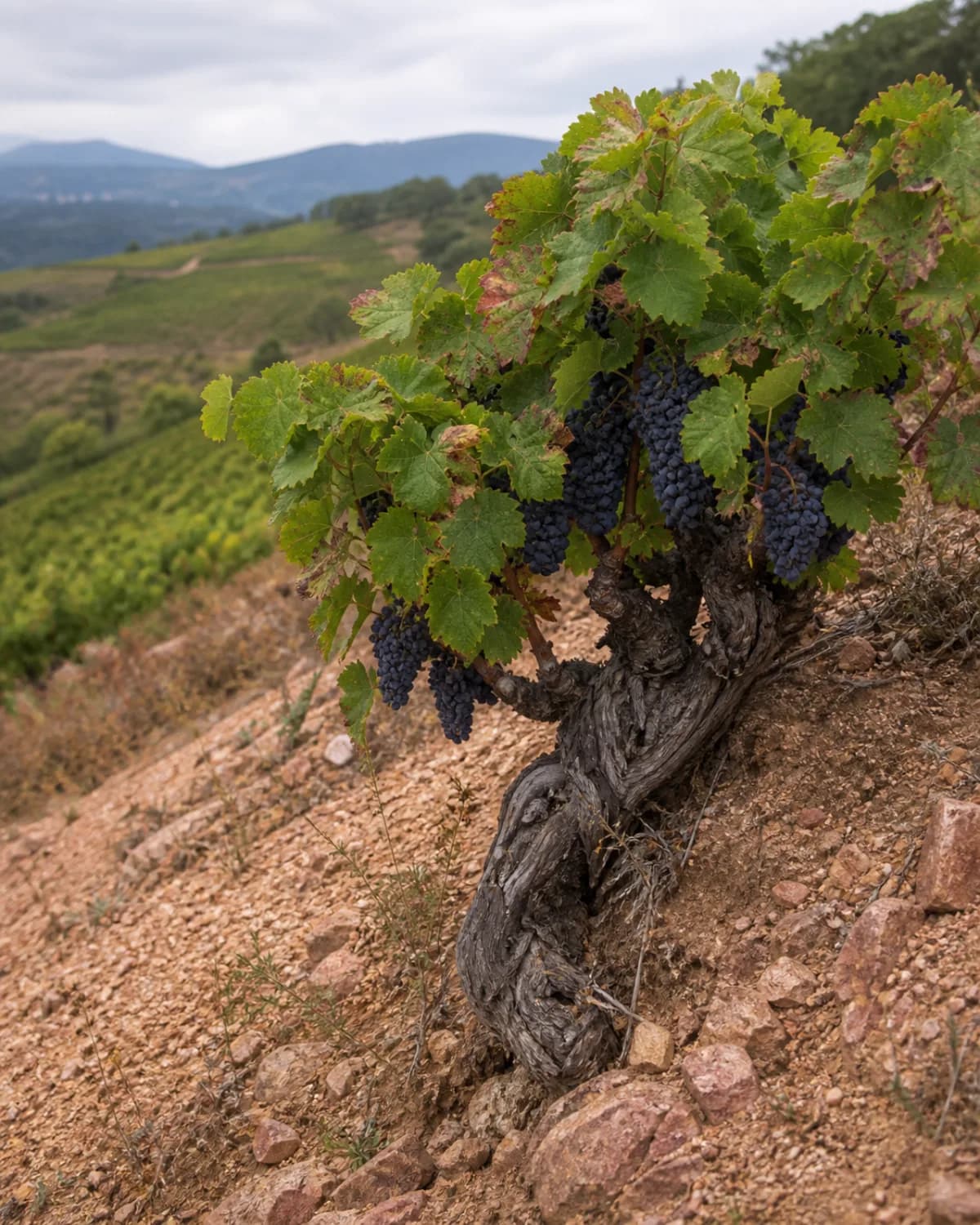
Pink granite becomes sand at different depths across the slope.
Search uses your saved shopping location. If none is set, Genuine Grape asks where you shop before looking for current bottles.
Pink granite is not one soil
Fleurie alone shows how uneven weathering and piedmont deposits complicate a granite label. Across Beaujolais, blue stone, schist, clay-limestone and alluvium add more variation.
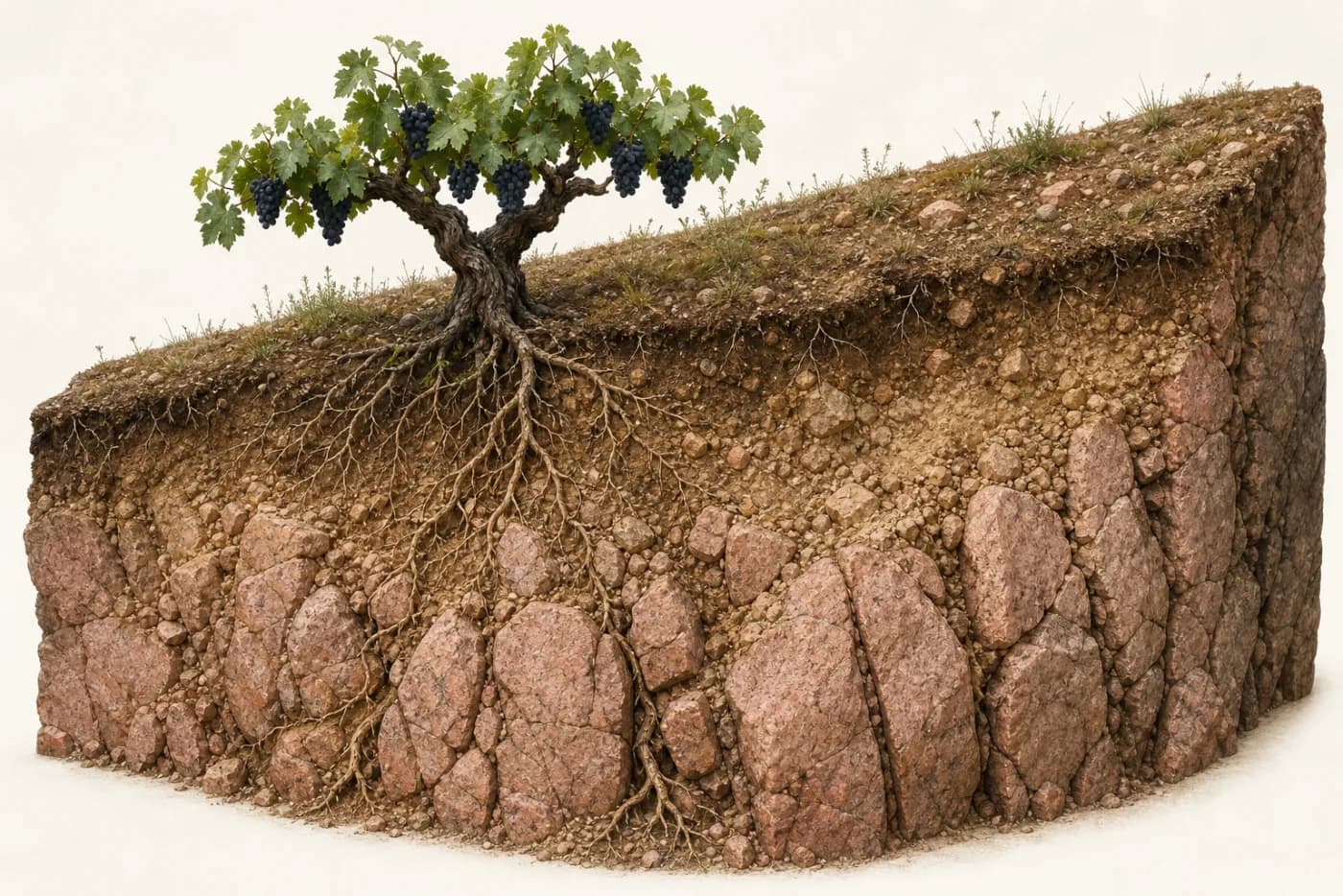
Weathered granite can form coarse, sandy soil with quartz and feldspar grains. Its depth and clay content determine how freely it drains and what it stores.
A shallow upper slope and a deeper lower slope can give roots very different volumes of fine earth, even within one granite-dominant climat.
Slope and weathering move fine material downhill. Growers manage erosion because the most useful root-zone material is not fixed in place.
Beaujolais includes granite, blue stone, schist, clay-limestone and piedmont deposits. The cru name should not be used as a universal soil label.
Where Gamay’s carbonic perfume comes from
Carbonic maceration begins inside intact berries in an oxygen-poor, carbon-dioxide-rich vessel. Semi-carbonic and whole-bunch approaches create related but not identical results.
Research: AWRI: carbonic macerationWhole fruit
Carbonic character depends on berries remaining unbroken long enough for intracellular processes to begin.
Low oxygen
Inside intact berries, malic acid and sugar begin transforming without conventional yeast fermentation.
Aromatic shift
The resulting perfume can override some varietal fruit character and is not evidence of granite flavour.
Finish
Temperature, time, stems and final fermentation determine how much carbonic character remains.
CO₂
An oxygen-poor vessel enables intracellular fermentation
01
CM
Carbonic maceration changes aroma and phenolic composition
02
WB
Whole-bunch and semi-carbonic methods are related, not identical
03
Four decisions behind the Beaujolais style
To predict the bottle, read the cru and the vinification together. The same granite slope can produce a bright early-release wine or a structured cellar-worthy one.
CM
01
Intracellular fermentation
It can produce distinctive strawberry, cherry, kirsch, spice and confectionery associations that should not be credited to the soil.
Research: AWRI: carbonic macerationSEMI
02
Mixed fermentation
The weight of the bunches releases juice at the bottom while upper berries may ferment intracellularly, creating a different balance from pure carbonic treatment.
Research: OENO One: carbonic macerationSTEM
03
Tannin + herbal detail
Stem inclusion is not only a route to carbonic character. It can also alter astringency, pH and herbal or spicy notes.
Research: IVES: Gamay fermentation with stemsAGE
04
Structure + time
Longer extraction and maturation can produce a more structured cru expression than the familiar Nouveau shorthand suggests.
Research: Beaujolais: Fleurie variationOne rock label, several root environments
Fleurie alone shows how uneven weathering and piedmont deposits complicate a granite label. Across Beaujolais, blue stone, schist, clay-limestone and alluvium add more variation.
Root zone
Thin sandy soil sits close to fractured parent rock.
Vine
Rooting volume and water reserve can be limited.
Watch
Elevation and exposure may amplify the vintage.
Root zone
More decomposed material creates a larger sandy root zone.
Vine
Roots can explore more volume and fine particles.
Watch
Deep does not automatically mean fertile or wet.
Root zone
Downslope mixtures can include deeper clay, sand and transported stones.
Vine
Water and vigour may differ from the upper slope.
Watch
The cru may still be marketed as granite-led.
Root zone
Morgon’s Côte du Py provides a major non-granite comparison.
Vine
A different weathering profile changes rooting conditions.
Watch
Serious Cru Beaujolais is not synonymous with granite.
Three crus, three ways to read the ground
The first two are strong pink-granite examples; Morgon shows why blue stone, schist and piedmont deposits must stay in the conversation.
Pink granite · varied depth
Fleurie is about 90% pink granite and piedmont deposits, but uneven weathering and soil depth create real variation among lieux-dits. The appellation’s floral reputation is not a substitute for parcel information.
Read the lieu-dit and producer, not the floral stereotype.
High elevation · pink granite
High-elevation Chiroubles is a particularly clear pink-granite example. Altitude, exposure and the depth of its weathered sandy soils still change how Gamay ripens from slope to slope.
Compare elevation, exposure and vintage.
Granite · blue stone · schist
Morgon is only partly granite; Côte du Py is associated with decomposed blue stone and schist. It is the useful counterexample to the idea that every serious Beaujolais cru is simply granite-grown Gamay.
Check the documented parcel before choosing a soil.
Predicting the bottle in front of you
The soil name becomes useful only when it sits beside place, vintage, farming and cellar choices.
Begin with the cru, then look for the named site. Fleurie, Chiroubles and Morgon contain different mixtures, depths, elevations and exposures.
Gamay ripens early. Heat, rainfall and harvest date can change fruit maturity and acidity more directly than the word granite alone.
Carbonic and semi-carbonic techniques depend on intact berries and can produce distinctive perfumed, kirsch-like and spicy characters.
Maceration length, pressing, stems and ageing determine how much tannin and structure the finished wine carries. Cru Beaujolais is not one cellar style.
Evidence, not geology folklore
This guide uses research and official regional sources. Bottle-level soil and winemaking still need to be documented for an individual search match.
Both vineyard images are original editorial illustrations; they do not depict a named vineyard, and the cutaway is not to scale.
Frontiers in Environmental Science
The Value of Soil Knowledge in Understanding Wine TerroirBeaujolais
Gamay and its relationship with Beaujolais graniteBeaujolais
The 12 appellations and more than 300 soil profilesBeaujolais
Fleurie pink granite, deposits and soil depthBeaujolais
Chiroubles and its pink-granite soilsBeaujolais
Morgon granite, blue stone and piedmont depositsBeaujolais
Régnié granite and piedmont soilsAustralian Wine Research Institute
Carbonic maceration technique and sensory effectsOENO One
Carbonic maceration and phenolic transformationIVES Open Science
Gamay fermentation with stems and aroma compositionGamay and granite questions
Does granite make Gamay taste mineral?
Not in a direct or guaranteed way. Granite-derived soils influence water, rooting and vine growth. A mineral tasting term is a sensory description, not proof that rock flavour entered the wine.
Why can Beaujolais smell like banana or bubble gum?
Those aromas are more closely connected to fermentation chemistry and techniques involving intact berries than to granite. Carbonic and semi-carbonic maceration can strongly reshape Gamay’s aromatic profile.
Is all Cru Beaujolais grown on granite?
No. Granite is important across the northern crus, but official mapping also shows blue stone, schist, piedmont deposits, clay, limestone and other formations.
What is carbonic maceration?
It begins with intact bunches in a carbon-dioxide-rich, oxygen-poor vessel, allowing intracellular fermentation inside unbroken berries before conventional fermentation finishes the wine.
Is Morgon a granite-grown Gamay wine?
Some Morgon vineyards are granitic, but the appellation also includes piedmont deposits and the decomposed blue stone and schist associated with Côte du Py. Check the particular site.
Can Genuine Grape find granite-grown Gamay near me?
Yes, when the vineyard detail is documented. Run the search, set where you shop if needed, and Genuine Grape will compare matching bottles from supported local wine shops.
Turn the cru comparison into a search
Set where you shop once. Then compare matching bottles, prices and current merchant availability in that market.