
01
Rain drains between fragments. Fine earth decides what stays.
Open fractures move water downslope. Clay and silt lodged between the stones hold part of it within reach of the roots after the surface dries.
Riesling × slate
Slate can change how quickly water drains, where roots grow and how warm exposed berries become. Those changes can reach acidity and aroma precursors—but the vine does not pull a slate flavour from the ground.
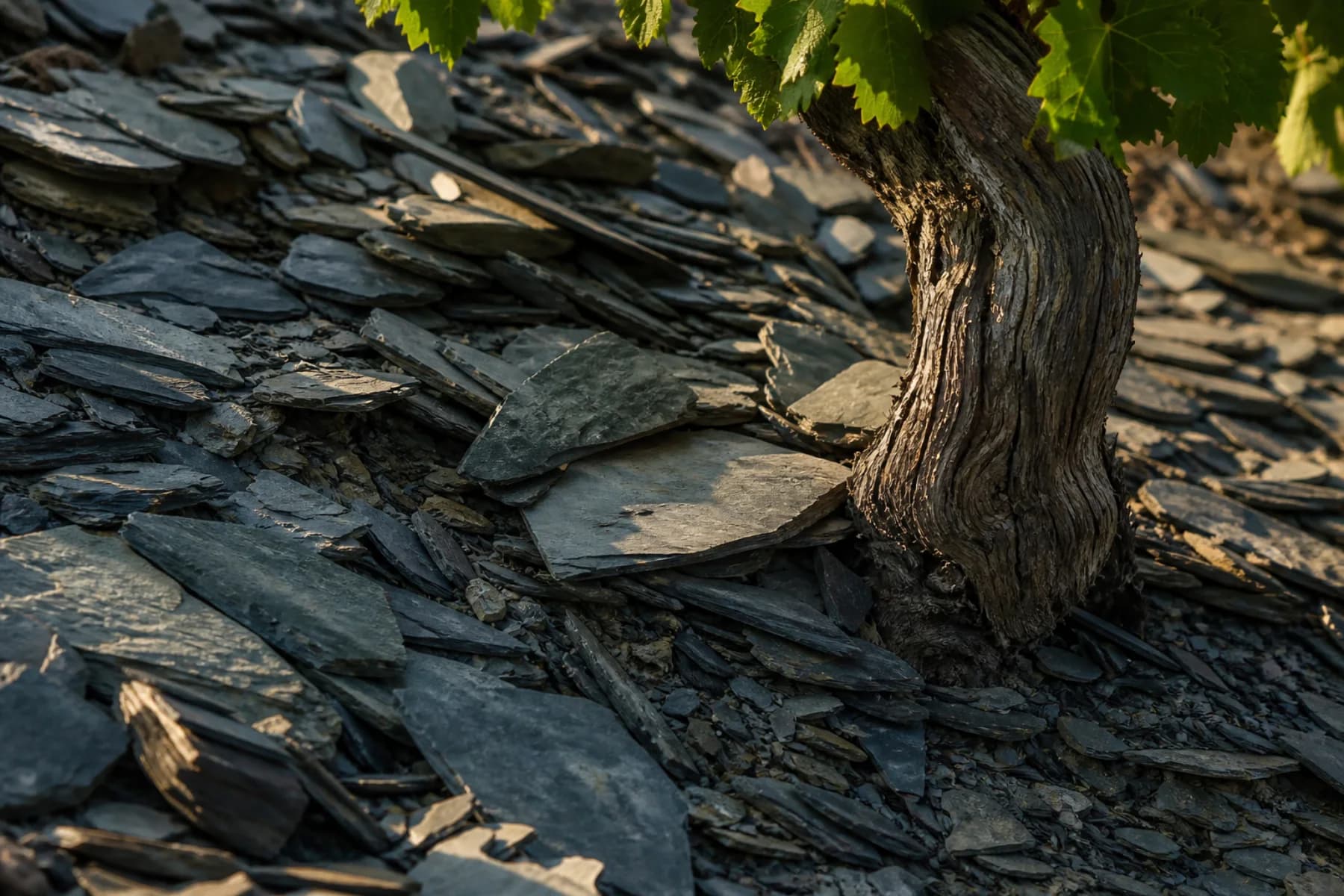
Slate is the setting. The vine is the response.
Search uses your saved shopping location. If none is set, Genuine Grape asks where you shop before looking for current bottles.
How slate reaches the grape
Rain moves through fractures. Roots follow the same openings. Sun heats the exposed surface. Riesling responds to all three before any aroma reaches the glass.
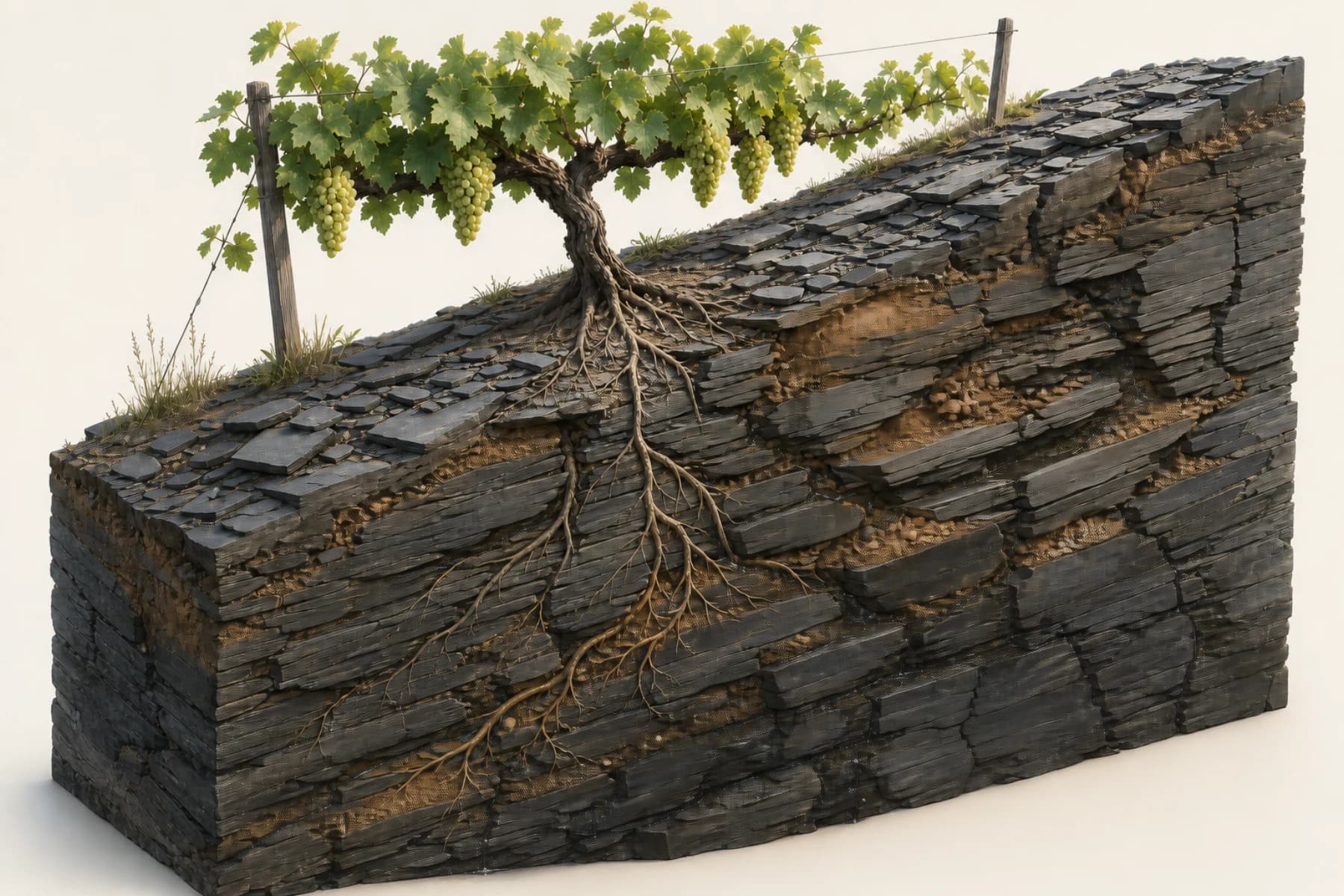
Usable water and nutrients sit in the weathered seams and fine-earth pockets between slate layers.
Slate cross-section
01
Open fractures move water downslope. Clay and silt lodged between the stones hold part of it within reach of the roots after the surface dries.
02
Fine roots branch through cracks and pockets of earth. The depth and continuity of that network set the vine’s usable reservoir for the season.
03
Extra warmth can help on a cool slope. During a hot vintage it also speeds malic-acid loss and increases the light-and-heat pressure that builds TDN precursors.
04
Berry temperature, sunlight and vine water status shift malic acid, monoterpenes and carotenoid-derived compounds before the fruit reaches the cellar.
Where Riesling’s petrol note comes from
The molecule is 1,1,6-trimethyl-1,2-dihydronaphthalene, mercifully shortened to TDN. At low levels it can sit inside Riesling’s aged character; at high levels it can cover the fruit.
What a Riesling experiment found
195 vs 54–87 µg/L
Leaf removal 33 days after berry set produced much more total TDN in grapes than the untreated and other-timing groups. Earlier or later removal did not show the same effect.
Research: Kwasniewski et al., 2010In the vineyard
Carotenoids protect the berry from excess light. Exposure and berry heat alter how those pigments accumulate and break down.
Inside the grape
Some breakdown products become bound precursors. You cannot smell petrol in the grape just because those precursors are present.
During fermentation
Fermentation converts part of the precursor pool, and yeast choice can change how much future TDN a wine carries.
During bottle age
The petrol-smelling molecule TDN forms gradually. Warmer storage and lower pH can accelerate precursor conversion.
~4 µg/L
Detection in one young-Riesling study
10–12 µg/L
Recognition as a distinct aroma
71–82 µg/L
Consumer rejection range in that study
Four routes from ground to glass
Soil enters each route through water and nutrient supply. Climate, canopy and cellar decisions then determine how much of that signal survives into the wine.
C₁₀
01
Floral and citrus aromas
Linalool, geraniol and related monoterpenes help create Riesling’s floral-citrus side. A field experiment found more free and bound monoterpenes in exposed berries than permanently shaded fruit. Too much exposure can also increase heat, sunburn and TDN risk.
Research: Friedel et al., 2016ACID
02
Acidity
Tartaric and malic acid are already inside the berry. In a Riesling heating experiment, warmer bunches had less malic acid. Soil matters indirectly when its water supply and surface conditions change canopy shade and berry temperature.
Research: Blank et al., 2019YAN
03
Fermentation aromas
Yeast-assimilable nitrogen includes ammonium and amino nitrogen in the must. It affects fermentation and the production of esters, higher alcohols and other volatile compounds. Soil supply is only one control: roots, cover crops, fertilisation, crop level and winery additions can all change the outcome.
Research: Riesling management trial, 2020K⁺
04
pH and potassium
Potassium is essential to the vine. In juice and wine it can bind with tartaric acid as potassium bitartrate, leaving less free acid and potentially raising pH. Soil availability matters, but so do rootstock, water flow, vine demand and winemaking.
Research: WSU Riesling acidity researchRiesling on different soils
These are starting tendencies, not flavour profiles. A deep slate site can hold more usable water than a thin clay site; management and vintage can reverse the simple stereotype.
Water
Usually drains quickly; storage depends on fractures and fine earth.
Vine
Deficit can arrive early. A smaller canopy may expose berries more.
Watch
In hot, dry years: berry heat, malic-acid loss and higher TDN potential.
Water
Often stores more water and nutrients through the season.
Vine
Can support more growth and shade unless the canopy is managed.
Watch
More shade may protect acidity and TDN, but excess vigour can delay or dilute ripening.
Water
Holds water and exchangeable ions well, but poor structure can drain slowly.
Vine
Water supply is buffered; vigour and potassium uptake can be higher in some sites.
Watch
Do not translate ‘clay’ directly into body or flavour—depth, drainage and crop load decide the response.
Water
Low storage and rapid drainage are common.
Vine
Roots can warm early and meet water deficit quickly without rain or irrigation.
Watch
The timing and severity of deficit matter more than the rock name.
Water
Ranges from thin and dry to deep clay-limestone with strong storage.
Vine
High soil pH can restrict some nutrients; rootstock and iron availability become important.
Watch
Limestone does not put acid into wine. Riesling acidity still depends strongly on temperature, ripeness and potassium.
Same rock word, different climate
The same soil mechanism changes meaning with rainfall, slope, sunlight and temperature. “Slate-grown” is the beginning of the comparison, not the conclusion.
Steep · cool · river-shaped
Riesling and steep vineyards define much of the Mosel. Slate appears in different colours and degrees of weathering, while slope, river exposure, vineyard position and producer choices keep the region from becoming one uniform style.
Read the specific slope, exposure and slate type.
Undulating · continental · cool nights
Wine Australia identifies broken slate at Polish Hill River. It is a precise regional example rather than a shortcut for all Clare Valley Riesling: the wider region has eleven recognised soil types, including limestone subsoils around Watervale.
Read Polish Hill River—not Clare Valley as one soil.
Predicting what you might taste
Those four clues sit closer to acidity, floral aroma and TDN than a generic claim that slate tastes “mineral.”
A cool river valley and a warm continental site do not use slate in the same way. Temperature and rainfall tell you whether drainage and surface warmth are helpful or stressful.
Slope direction and canopy shade change how much light and heat reach the berries. That can shift monoterpenes, malic acid and the precursor pool for TDN.
A shallow site in a rainy year can behave differently from the same site in drought. Ask when water deficit began and whether it stayed mild or became severe.
TDN develops from precursors during fermentation and ageing. Yeast, wine pH, storage temperature and years in bottle can matter more than the soil name.
Evidence, not folklore
This guide uses peer-reviewed soil research and official regional sources. Bottle-level soil still needs to be documented for an individual search match.
Hero image is an editorial illustration of fractured slate; it does not depict a named vineyard.
Frontiers in Environmental Science
The Value of Soil Knowledge in Understanding Wine TerroirJournal of Agricultural and Food Chemistry
Timing of cluster light exposure affects TDN precursors in RieslingAustralian Journal of Grape and Wine Research
Light promotes monoterpene metabolism in Riesling berriesOENO One
Temperature and solar radiation alter Riesling malic acidOENO One
Soil, vine water status and performance in Ontario RieslingMolecules
TDN sensory thresholds in Riesling wineWine Australia
Clare Valley soils and climateRiesling and slate questions
Where does the petrol smell in Riesling come from?
It comes mainly from TDN, a potent aroma molecule that forms from carotenoid-derived precursors. Sunlight and berry temperature influence the precursor pool in the vineyard; yeast, wine acidity, storage temperature and bottle age influence how much TDN appears later. Slate is not a direct source of TDN.
Does slate make Riesling taste mineral?
Not in a simple or guaranteed way. Soil affects the vine through factors such as water, nutrients and temperature, but climate, grape material, vintage, farming and winemaking also shape the finished wine.
Is all Mosel Riesling grown on slate?
No. Slate is an important part of the Mosel’s identity, but vineyard geology and soil vary. Check the documented site for the individual wine rather than inferring soil from the regional name alone.
Is all Clare Valley Riesling grown on slate?
No. Polish Hill River is known for broken slate, while Clare Valley contains several other soil settings. Watervale, for example, is associated with limestone in its subsoils.
Does limestone make Riesling more acidic?
Not directly. Limestone-derived soils can change water supply, root growth and nutrient availability, but the acids in Riesling are made by the grape. Berry temperature, ripeness, potassium uptake and winemaking have more direct effects on measured acidity and pH.
Can Genuine Grape search for slate-grown Riesling near me?
Yes, when the vineyard detail is documented. Run the search, set where you shop if needed, and Genuine Grape will look for matching bottles across supported local wine shops.
Turn the question into a search
Set where you shop once. Then compare matching bottles, prices and current merchant availability in that market.